
Website design for therapists, from what's included to who to hire

Somebody's been putting off finding a therapist for the past 8 months. But tonight's the night. They open 4 tabs on their phone, and one of them is yours.
What they see in the next 30 seconds decides if they ever reach out. Can this person help with what I'm dealing with? Would I feel comfortable talking to them? What's this going to cost me? What happens if I click that button?
A lot of therapist websites don't answer any of that. They've got a stock photo of stacked stones and a paragraph about providing a safe space. (Every therapist on the internet offers a safe space, so that line isn't helping anybody choose you.)
If you're here, I'm guessing you're past wanting a website just to have one. You have a practice, you've probably got a Psychology Today profile, and you're ready to hire someone to build a site that brings in the clients you want to work with the most.
I've built 30+ websites for beauty and wellness pros, including a lot of therapists, counselors, and group practices. So here's what good website design for therapists includes, what it costs, and how to pick who builds yours.
Why Therapist Website Design Is Its Own Thing
Most websites get skimmed. A therapist's website gets read. Somebody's deciding who to tell the things they haven't even told their best friend, so they're going through your About page the way you'd go through a first date's Instagram. Every line. Probably twice.
You also don't get the shortcuts other businesses get. Transformations happen, but they're not always visible. A hair salon can show a before-and-after. You can't. Most professional ethics codes say not to ask current clients for testimonials either. So your words, your photos, and how your site's organized have to do the work to build that trust.
And no, having a website doesn't mean ditching your Psychology Today profile. Most of my therapist clients keep theirs, and I'd tell you to keep yours too. When everything's playing nicely, directories are where people come across your name. Your website brings them into your world. It's the filter that helps them get to know you on a personal level and decide you're the right fit.
7 Things Every Therapist Website Needs
1. A homepage that says who you help right away
Within a few seconds, a website visitor should know who you work with, what you help with, and if you see clients in person, online, or both.
This is where a lot of therapists get nervous. Listing "individuals, couples, families, and teens" feels safer than naming your person. But most of the therapists I work with want to be known for something. THE therapist for new moms. THE counselor for Black women. You don't get there with a homepage that's trying to talk to everybody in your zip code.

2. Real photos of you
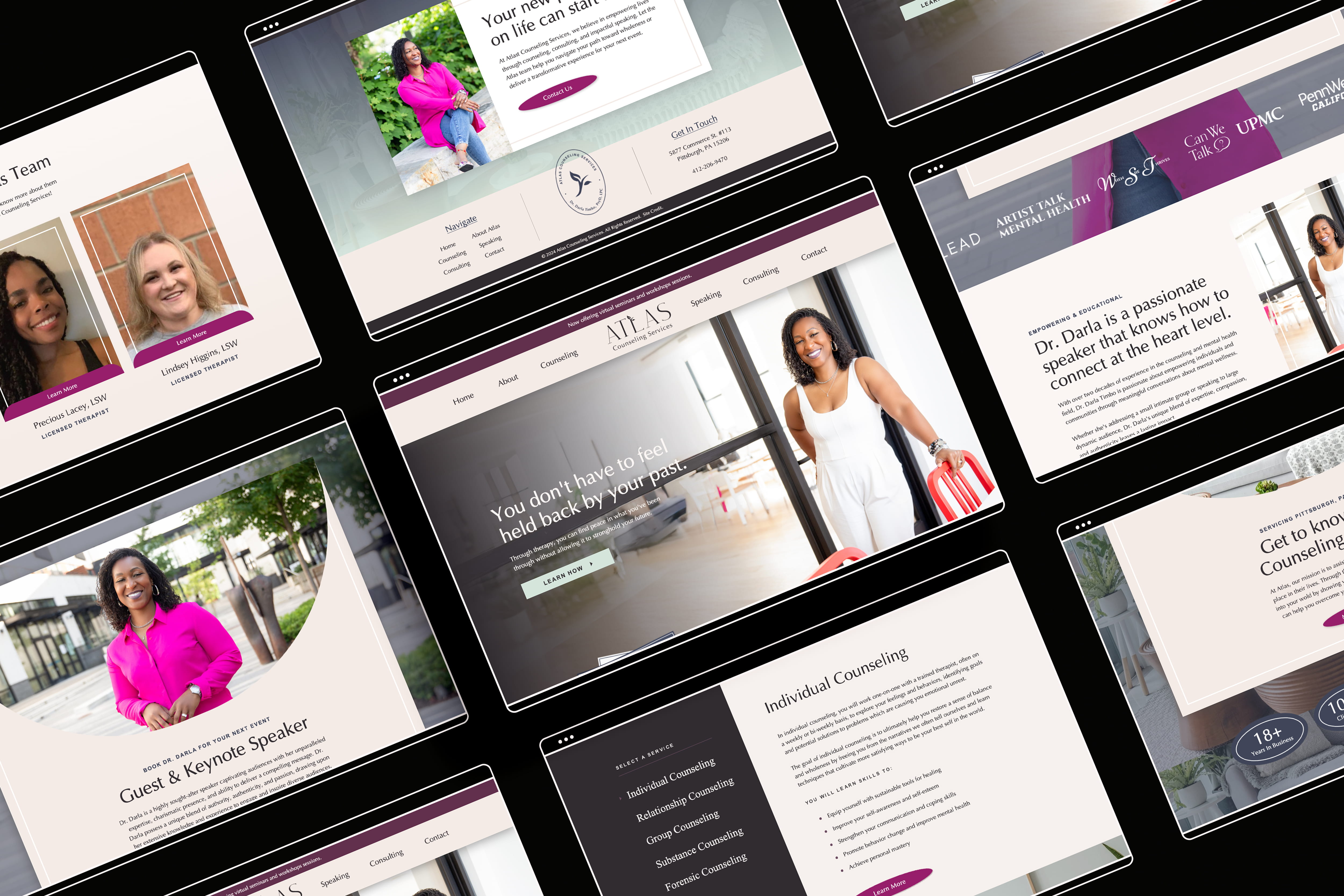
People are choosing a person, so let them see one. Before Dr. Darla Timbo, Psy.D., LPC, came to me, Atlas Counseling Services leaned on stock photos and most people didn't stay on the site long. We put her face, her personality, and her years of experience in the forefront. Within 3 months, she was fully booked with individual counseling clients for the rest of the year. (Photos weren't the only thing we changed, but they definitely did a lot of the talking.)
Ready to ditch your stock website photos? Here's how to plan a brand photoshoot for your site.
3. A page for each specialty
Anxiety, couples counseling, trauma, and EMDR shouldn't all be sharing one long services page. When someone searches "EMDR therapist near me," Google wants to show a page about EMDR. And when that person lands on it, they want to feel like you wrote it about them. (I go deeper on this in my beginner's guide to SEO for therapists.)
The only exception to this is if you're just launching your practice. If that's the case, you don't need all of these pages on Day 1. Starting with a small site or even a one-page website is completely fine until you get a better feel for the services you want to offer, the type of clients you want to see, etc.
But those specialty pages do need to get built eventually. Once you're in year 3, 4, or 5+ of your practice, you need a page for each specialty you want to be found for, because you're not going to rank for them without one.

4. Your fees & accepted payment methods
No one wants to search high and low for your fees on your website. And no one wants to get on a consultation call just to find out they can't afford you.
Share your session rate and any insurance you accept. If you're out of network, explain how superbills work. And if you're private pay, this is your chance to explain what people get by paying out of pocket.
Yes, some people will leave when they see your rate. That's one less consult from a bad-fit client that you didn't have to take.
5. A low pressure & easy-to-find next step
Pick your main next step (for most therapists, that's requesting or scheduling a free consultation) and put it in your navigation and at the end of every page. Then tell people what happens after they click it. Someone who's nervous wants to know if they're about to get a form, a phone call, or a video chat.
When Brittany Maxshure, MSW, MPH, LCSW, hired me, she was running Littlejohn Counseling & Consulting part time and handling every inquiry herself. In a recent 28-day stretch, her site brought in 14 consult requests before she had to send a single email.

6. Forms that protect your clients
Standard website forms aren't HIPAA-compliant, and that includes the ones built into Webflow and Showit. So keep your contact form simple (name, email, and how they'd like to be reached), and send anything with health information through a secure tool that'll sign a Business Associate Agreement with your practice.
I'm a website designer, not a lawyer, so run the specifics by your attorney. I cover the rest in my guide to website legal requirements.
7. Trust signals aka social proof
You may not be able to ask current clients for reviews the way a lash artist can, but you can still feature them on your website. Many of my counselor clients share what people have already posted publicly on Google or Facebook. (Just check your code of ethics or licensing board first.)
You'll also want to show people why they can trust you in other ways. Your license and credentials, your training, how long you've been doing this, and where you've spoken or been featured. A short video of you talking is one of my favorites, because it lets someone hear your voice and communication style in a low pressure way.
Lab Tip 💡 - Read your homepage out loud. If it doesn't sound like how you talk in session, it's going to be hard for someone to get a real feel for you.
If You Run a Group Practice
Group practices have a different set of website needs. Clinicians come and go, services change, and the website's usually the last to find out.
When I started working with Vision Towards Peace, their site was four years out of date and missing over 20 of their providers. Their front desk staff kept answering the same questions, and every update meant someone had to design a page from scratch.
I moved them from Squarespace to Webflow and built provider profiles they can update without designing anything, a filterable FAQ page, and a careers page. Comparing their last month on the old site to their first month on the new one, website sessions went from 705 to 2,497.
If you're a group practice owner, your site needs a profile for each clinician that shows who they work with, an easy way for visitors to find the right person, and a setup your team can update on its own.

Common Therapist Website Mistakes
- Writing for other clinicians. Your future client isn't searching for your modality. They're searching for why they can't sleep and keep snapping at their kids. Talk about what they're going through first, then explain how you work.
- Being so calm you never say what you do. A beautiful site that never says "couples counseling in Columbus" doesn't give Google much to work with. Name your city and every state you're licensed in.
- Forgetting the phone. Around 65% of your visitors are scrolling your website on a mobile device. If they have to pinch and zoom to find your consult button, they're gone.
- Leaving old stuff up. A service you stopped offering two years ago, a clinician who left, a podcast you stopped recording. It all makes people wonder if anyone's home.
- Signing up without asking who owns it. Before you sign with a marketing company or anyone that promises monthly website services, ask what happens to your site and domain if you leave. Every client I've ever worked with owns theirs outright, and honestly, you should too.
Who Should Build Your Therapist Website?
In my experience, most therapists end up deciding between a template and a custom designer. Here's how I'd think about it.
You, with a template
A solid place to start if you're brand new and the budget's tight. Just know you'll be the one writing the copy, handling the SEO, and fixing things between sessions.
A designer who customizes a template
Usually about $1,000 to $3,000. It'll look polished and it's faster, but the sections are premade, so your practice has to fit them.
A website designer for therapists
You're reading this on a web designer's blog, so you had to see this one coming.
A web designer who specializes in therapists already knows what your clients need to see, so you're not spending your consult explaining what a superbill is.
When you work with me, you work with me from the consultation call to launch day. I handle the strategy, the design, and the build, and I can write your copy or edit what you write. Schema markup and foundational SEO are part of every build. And you own your domain and your website, so if you never hire me again after launch, it's still all yours.
Whoever you're considering, ask to see the therapist sites they've built and what changed after launch. Then look over my 5 questions to ask before hiring a web designer.

How to Know You're Ready for a Custom Website
A custom website makes sense when:
- Your practice is established, but referrals and directories aren't bringing in enough of the right clients (The keyword here is right clients. You won't feel as fulfilled with your work if you're counseling kids when you'd really rather be working with single moms navigating divorce, for example.)
- You're raising your rates or moving toward private pay
- You're adding clinicians or growing into a group practice
- You want to be known for a specific specialty
- You've got the budget for it, and you'd rather spend your evenings on anything but your website
If you just opened your doors and money's tight, a template's a smart move. Most people's first website isn't custom anyway. And if you already have a site but you're not sure if it needs replacing, a Polished Pages Audit is $497 and tells you what's costing you clients and what to fix first.
How Much Does Website Design for Therapists Cost?
Custom website design for therapists usually runs from $2,000 to $10,000+, depending on how many pages you need and how much gets handled for you. I price my Workhorse Websites by page count, and here's where a few common sizes start.
A solo therapist can often start with 1 to 3 pages and add more later. A group practice with clinician profiles and a page per specialty will need more room. Copywriting and add-ons (like a HIPAA-compliant intake form or a blog) are priced on top of that, and my project builder gives you a project quote in 2 minutes or less.
Outside of the build, plan for your website platform (usually $22-$39 a month on Webflow or Showit), your domain (around $20 a year), and brand photos (varies). For a more in-depth idea of what moves the price up or down, here's how much a website costs for a beauty or wellness business.
Is it worth it?
Run your own numbers, but here's an example. A client who sees you weekly at $150 for 6 months is worth about $3,900. A 3-page website starts at $3,750. So 1 long-term client can cover it, and the site's still there working for you after that. (I can't promise your site will bring in a certain number of clients. Nobody honest can or will.)
Therapist Website Design FAQs
How many pages does a therapist website need?
A 1-page site can work if you're launching for the first time, and you can add pages as you grow. An established practice usually wants a homepage, an about page, a page for each main specialty, and a page for fees and insurance.
What's the best website platform for therapists?
There isn't one best option for everybody. I build on Webflow and Showit. Showit's great for a smaller site you want to be able to design yourself (similar to Canva), and Webflow's better if you plan on adding clinicians, specialties, or a blog. Here's how Webflow compares to Showit and Webflow compares to Squarespace.
Do I still need a Psychology Today profile if I have a website?
To me, the two are like peanut butter and jelly. I'd recommend having both. Psychology Today helps people come across your name, and your website helps them decide you're the right fit.
Can I put client testimonials on my therapy website?
Be careful with this one. Most professional ethics codes say not to ask current clients for testimonials, and the rules can vary by license and state. Many of my counselor clients feature reviews people have already left publicly on Google or Facebook. Check your code of ethics or licensing board first.
Your Website Should Be Doing Some of This for You
You already spend your whole day showing up for other people. Your website should be the thing introducing you, answering the money questions, and sending the right people to your consult link while you're in session.
That's what I build. I call them Workhorse Websites, pretty enough to make you proud and working hard enough to keep your caseload where you want it. If that's what your practice needs, learn more about Workhorse Websites for therapists and use the project builder to get a quote.