

How can I support your website right now?

Why websites stop converting after a few years
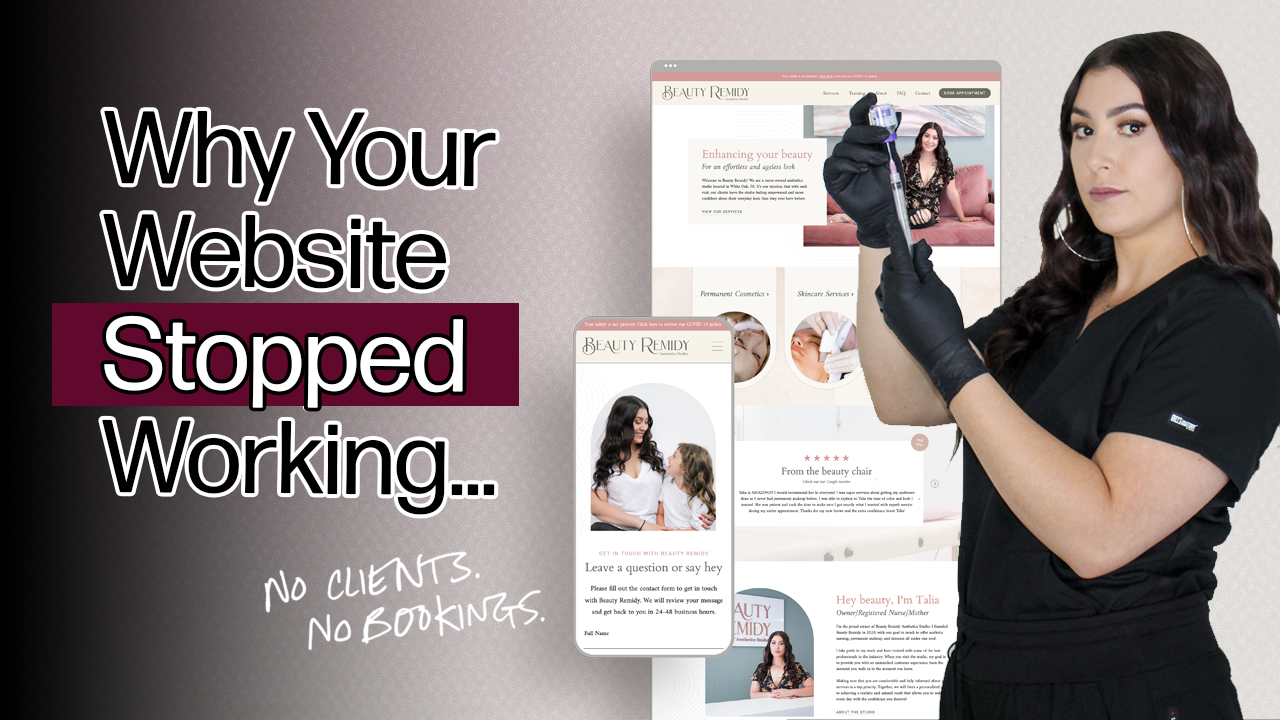
Rather not read? Watch the video instead!
Do you ever miss the buzz of your website’s glory days?
You know, the launch phase. When your site went live, your friends and family shared the link without you even asking. When everything felt shiny and new, inquiries and bookings rolled in with surprisingly little effort.
Yeah. Those were the days.
But as the time passed, something shifted. That initial excitement, you and everyone else had, slowly faded away. Now your website is collecting a bit of virtual dust. It still looks good, but bookings aren’t as consistent as they used to be, and you’re starting to wonder why your website isn’t booking clients.
Like most business owners, your first instinct is probably to rebrand, relaunch, or redo everything. You want that buzz back. And while new brand colors and a fresh photoshoot can be fun, they’re rarely the full solution. More often, they’re just treating the surface of a much bigger problem:
Your business has entered a new phase, but your website hasn’t evolved with it. And that’s exactly why websites that are built to grow with your business matter.
The Website Lifecycle (That No One Talks About)
Your business is your baby. And just like a baby goes through different stages—from the newborn stage where it’s 100% dependent on you, to the school-aged years where they start to gain a sense of identity, to the preteen stage where independence kicks in—your business evolves over time.
And guess what? Your website should too.
What worked for your website in year one won’t fully support your business in year four. As your business matures, your ideal clients shift and your visibility grows, your website needs to do more than exist, it needs to adapt.
After six years of designing websites for beauty and wellness businesses, these are the lifecycle stages I see most often:
- Stage 1: The “Just Get It Live” Website
- Stage 2: The Visibility-Building Website
- Stage 3: The Authority Website
- Stage 4: The Recalibration Website
At first glance, can you guess which stage your website is in? Don’t worry, we’ll break down each phase in detail in the following sections. But it’s always fun to take a quick guess before we dive into the data. (And if you’re still unsure which stage your website is in after reading this blog post, that's exactly what I help business owners figure out during a website audit.)
Stage 1: The “Just Get It Live” Website
When you’re early in business, everybody and their mom will preach to you the importance of having a website. So even if it feels overwhelming, and you don’t know the first things about domains, hosting, or page layouts, you eventually get something online.
And honestly? That’s a win.
At this stage, most business owners don’t have the budget (or the desire) to hire a website designer for a fully custom website, and that’s totally normal. You’re scrappy. Pinterest and competitor websites become a part of your daily scroll for inspiration. Templates, DIY platforms, and “launch fast” resources become your best friend.
SEO? It’s usually an afterthought, if it’s on your radar at all.
In this phase, your website’s job is simple: to exist. It’s there to legitimize your business, give people somewhere to land, and support referrals. And for a while, it works. Friends share your site. Past clients send people your way. Inquires trickle in without much effort.
But this kind of website isn't built to scale.
Eventually, referrals slow down. Social reach fluctuates with the everychanging algorithm. And the website that once felt “good enough” starts to feel...quiet.
That doesn’t mean you did anything wrong. It just means your business is growing (which is a good thing!). Your website just hasn’t caught up yet.
Stage 2: The Visibility-Building Website
The good news? People are finding your website. The bad news? They aren’t doing much beyond that.
This is usually the phase where business owners start investing in visibility—whether that’s posting on their social accounts more consistently, dabbling in SEO, paying for ads, or simply being in business long enough that people start Googling them.
Their website traffic increases. Awareness grows. But website conversions don’t follow at the same pace.
Why?
Because the website was never designed to support decision-making.
At this stage, your website visitors aren’t just looking to confirm that you exist. They’re comparing options, scanning for clarity, and trying to decide if you’re the right fit. But many “Stage 1” drop the ball here.
Their messaging is vague. Services aren’t clearly differentiated from their local competitors. Buttons are buried, missing, or generic. And the website assumes visitors already trust you, when most of them don’t yet.
This is where a lot of business owners start saying things like:
- “People keep asking questions that are already on my website.”
- “I see people are visiting my website, but no one is booking.”
- “I think my website just needs a refresh.”
Here’s what’s really happening: Your visibility has outgrown your strategy, which is exactly when a strategic website audit becomes invaluable.
Your website is doing its job of attracting people, but it’s not guiding them. And without updates to it’s messaging, structure, and user experience, the gap between site traffic and landing conversions is only going to get wider and wider.
Stage 3: The Authority Website
This is the stage most business owners want to be in.
Your visibility is solid. You no longer have to give a 10-minute explanation when people ask what you do. People are finding you through search, referrals, and the reputation you’ve built, not just Instagram.
You’ve worked with enough clients to spot patterns, refine your processes, and realize that not every client is your client. Naturally, your business starts to specialize in something.
But here’s the catch: Many websites don’t evolve past generalist mode.
At this stage, your website should be doing heavier lifting: positioning you clearly, filtering inquiries, and supporting higher price points. Instead, it often still speaks to everyone, which ironically makes it resonate with no one in particular.
Common signs a website is stuck in late Stage 2 / early Stage 3:
- Your services have evolved, but your website hasn’t.
- You’re better at what you do, but your site doesn’t reflect that depth.
- You want more aligned inquiries, not just more inquiries.
- Your pricing has increased, but your website hasn’t done a good job of justifying the shift.
This is where having a website strategy becomes non-negotiable.
Not more pages. Not trendier design. But clearer messaging, stronger structure, and intentional pathways that support decision-making.
When a website successfully adapts at this stage, it becomes a true business asset.
When it doesn’t, it quietly sets the stage for the next phase.
Stage 4: The Recalibration Website (aka Is It Time for a Rebrand?)
This is where businesses really start to feel stuck.
The buzz of the original launch has officially worn off. Brand visibility and recognition have increased. You’re known for something, but your website hasn’t kept pace with who you’ve become or who you’re attracting now.
Your clientele has changed. Their expectations are higher. Their objections are different. And yet, your website is still speaking to an earlier version of your business.
This is often when business owners feel the urge to blow everything up and debate a rebrand vs a website refresh.
A rebrand. A relaunch. A total redo.
But here’s the truth most people don’t talk about: Most businesses don’t actually need a full rebrand. (And that’s coming straight from the woman running a business called The Rebrand Lab.)
In fact, rebrands done prematurely, or without strategy, can do more harm than good. They can erase hard-earned visibility, disrupt SEO momentum, and confuse an audience that already recognizes and trusts you.
What’s usually needed instead is strategic recalibration, which typically includes:
- Updating your messaging to reflect a more refined audience
- Restructuring your services to better support your growth (and boundaries)
- Addressing the objections your current clients actually have
- Optimizing your website to convert colder, more cautious traffic
Reaching a business plateau isn’t a failure. It’s a signal.
Your business has outgrown the version of your website that got you here, and now your website needs to evolve with intention, not impulse.
The Real Problem: No Lifecycle Awareness
Despite what most business owners believe, websites aren’t “set it and forget it” assets. They’re living systems that need to evolve alongside your business—growing, adapting, and recalibrating as you move throughout each phase.
Intentional evolution doesn’t mean constantly rebuilding from scratch. It means making thoughtful updates after your website launches: refining your messaging, maintaining your SEO, and improving your website’s user experience (UX) so your site continues to support how people find you, and how they decide to book with you.
And if you don’t? You end up with a website that “just doesn't work anymore”.
Ask me how I know. (This is exactly what I share first hand in A Behind-the-Scenes Look at My Website Redesign).
Here’s what finally clicked for me: Using a website design for a Stage 1 business when you’re operating in Stage 2 or beyond, is like an adult trying to run a marathon in their favorite childhood shoes, or using an expired prescription and wondering why you still don’t feel better.
It’s like running iOS 7 on a phone that should be running iOS 26.
The problem isn’t your business. It’s the website you’re still relying on to support it.
How to Tell If Your Website's Aged Out
If you’re starting to wonder if your website has outgrown your current stage of business, the good news is you don’t need to burn everything to the ground to figure it out.
Here are a few tell-tale signs that that tell story:
- You’ve noticed that your website traffic is increasing but your bookings have stalled.
- Your website visitors don’t understand your services quickly, or keep asking you about services you no longer offer.
- When people inquire, you find yourself covering the same information with them that should already be clear on your website.
- Visiting your website feels like a Throwback Thursday moment. It looks like who you were, not who you are now.
If a few of these feel uncomfortably familiar, it’s not a coincidence, it’s a lifecycle mismatch. Starting with a website audit can help you figure out exactly what needs to change and what doesn’t.
The Takeaway
Understanding which phase of business you’re in is key to evaluating whether your website is actually supporting you or actually holding you back.
Websites that continue to convert over time aren’t the ones that chase constant rebrands or redesigns. They’re the ones that are maintained with intention, which is exactly how I support websites long after launch.
Your website doesn’t need to be brand new. It needs to be aligned.
And once websites are aligned, conversions tend to follow.

You may also like...
.jpg)

Google's recent AI updates have business owners convinced that SEO is dead and websites don't matter anymore. Here's why they're wrong, and what beauty and wellness professionals actually need to do to stay visible and keep booking clients.

Schema markup keeps coming up on consult calls, and most people asking don't know what it actually is. Here's what it does, why not all schema is created equal, and how it's handled inside every Workhorse Website build.

